
Readers often ask whether cozy mysteries and amateur sleuth mysteries are the same thing. They overlap, but they answer to different rules.
A cozy is a tone and a set of content limits. An amateur sleuth story is defined by who solves the crime. You can have one without the other.
Key takeaways
- **Cozy mystery** describes the tone and content: low violence, no graphic sex, no gore on the page, a small community setting, and a puzzle that feels safe to solve from your armchair.
- **Amateur sleuth** describes the detective: an ordinary person with no badge or PI license who solves the crime, from a baker to a reporter to a retired lawyer.
- Most cozies use an amateur sleuth, which is why the two labels get confused, but not every amateur sleuth story is a cozy.
- The clearest test: cozies limit what happens on the page (violence, language, sex); amateur sleuth stories only require who does the detecting.
- A gritty small-town mystery with an ordinary protagonist, an on-page murder, and salty language is amateur sleuth but not cozy.
- If you like character-driven crime fiction with real emotional stakes but you don’t need the sanitized tone of a pure cozy, you’re usually looking for amateur sleuth or “traditional” mysteries.
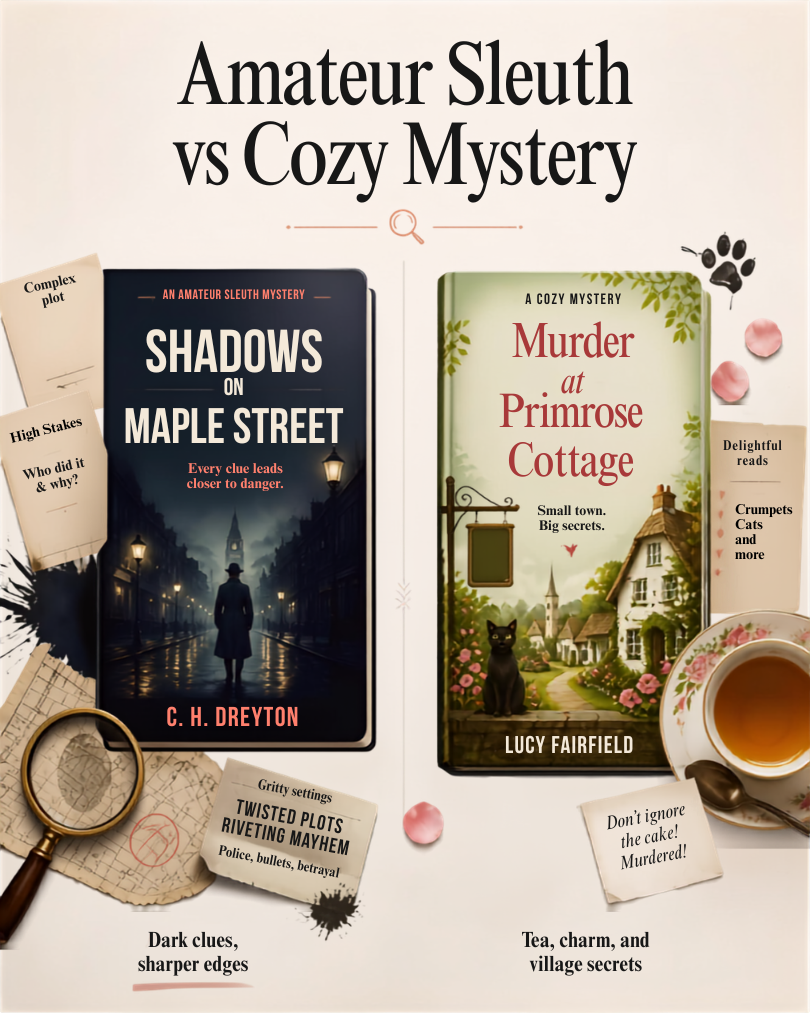
What is a cozy mystery?
A cozy mystery is a subgenre defined by its gentle tone and strict content limits, not by who solves the crime. The violence happens off the page, there’s no graphic sex or gore, profanity is minimal or absent, and the setting is usually a tight-knit community: a village, a small town, a bookshop, a bakery. The reader gets the pleasure of the puzzle without the discomfort of the darkness.
The conventions are remarkably consistent. Agatha Christie’s Miss Marple books set the template, and the modern cozy shelf runs on it: a warm amateur detective, a body discovered early but not lingered over, a closed circle of suspects who all know each other, and a satisfying reveal where order returns to the community. Themed cozies (culinary, crafting, pet, holiday) took that formula and built entire series around a hook.
What a cozy promises the reader is comfort. You know going in that you won’t be ambushed by a graphic autopsy or a torture scene. That predictability is a feature, not a flaw. It’s why the subgenre keeps such a loyal readership.
What is an amateur sleuth mystery?
An amateur sleuth mystery is defined by the detective: an ordinary person, not a police officer or a licensed private investigator, who solves the crime. That’s the whole requirement. The sleuth might be a journalist, a schoolteacher, a caterer, a librarian, or a lawyer who left the courtroom. What matters is that they have no professional mandate to investigate. They get pulled in because the crime touches their life.
That amateur status changes how the story works. A professional detective has resources: a badge, forensic labs, the authority to compel answers. An amateur has none of that. They investigate through relationships, curiosity, local knowledge, and stubbornness. They have to talk their way into information a cop could simply demand. That constraint is what makes amateur sleuth stories so character-driven. The detective’s personality, history, and connections in the town are the tools they solve the case with.
Amateur sleuth is a broad category. It says nothing about tone. You can write a bloody, high-tension amateur sleuth novel or a gentle one. The label only tells you who’s doing the detecting.
What are the actual differences between the two?
The core difference is that “cozy” limits content and tone, while “amateur sleuth” defines the detective’s role. Here’s how they line up across the features readers care about.
| Feature | Cozy Mystery | Amateur Sleuth Mystery |
| Definition based on: | Tone and content limits | Who solves the mystery |
| Sleuth | 99% of time an amateur | Amateur (no badge or license) |
| Violence | Off-page, minimal | On-page, off-page, mild, or graphic |
| Language and sex | Clean, family friendly | No restrictions |
| Setting | Usually small, tight community | All types, often small town |
| Emotional Intensity | Light, reassuring | Varied, can be dark and personal |
| Reader Promise | Comfort, safety | Capable, ordinary sleuth |
Think of it as two questions that don’t have to match. First: how dark does this book get? That’s the cozy question. Second: who cracks the case? That’s the amateur sleuth question. A book can be an amateur sleuth story with an on-page murder, real grief, and strong language, and still not qualify as a cozy because it breaks the content limits.
The overlap is huge, which is where the confusion comes from. Most cozies use amateur sleuths, so if you’ve mostly read cozies, every amateur sleuth looks like a cozy to you. But the reverse doesn’t hold. Plenty of amateur sleuth fiction sits outside the cozy fence.
Where do the two overlap and where do they split?
They overlap in the great majority of published cozies, and they split at the edges of tone. A culinary cozy about a bakery owner who solves a poisoning is both a cozy and an amateur sleuth story. That’s the Venn-diagram center where most people live.
The split shows up in books like these:
- Amateur sleuth, not cozy: An investigative reporter chases a killer through a small town, the murder is shown, the stakes are life-and-death, and the language is real. Ordinary protagonist, no badge, but too dark for the cozy shelf. This is the space my Breaking News Mysteries live in. In Breaking News: Local Heiress Dead, reporter Olivia Mercier races the clock against a killer while her marriage to the local homicide captain falls apart around her. Amateur sleuth, yes. Sanitized cozy, no.
- Cozy, technically an amateur but barely present as one: Some village mysteries lean so hard on the community and the puzzle that the “detective” is almost incidental. Still cozy, still amateur, but the emphasis is all tone.
- Neither: A police procedural or a licensed-PI thriller. No amateur, and usually not cozy either.
My own work tends toward the darker, more emotionally loaded side of the amateur sleuth line. The Gabrieli Mysteries follow Gabe, a former lawyer turned part-time PI, so he’s edging out of pure amateur territory, but the books still run on personal stakes rather than institutional resources. In The End Game, Gabe has to clear his kid brother of a murder charge. That’s not a comfortable armchair puzzle. That’s a man’s family on the line.
Which one should you read, and how do you tell before you buy?
Read the content signals, not just the label, because bookstores and retailers use the terms loosely. Here’s a practical test:
If you want to be reassured, choose true cozy. Look for a punny or themed title, a cartoon-style cover, a series built around a hobby or a shop, and back-cover copy that promises charm. You’ll get a puzzle without the dark.
If you want an ordinary hero but you don’t mind the story going to hard places, choose amateur sleuth and check the tone signals. Read the first few pages. Is the murder on the page? Is the language real? Are the emotional stakes personal to the sleuth? If yes, you’re in richer, darker amateur sleuth territory, which is where character-driven crime fiction usually sits.
My honest opinion, and it runs against the marketing habit of shelving everything with an amateur detective as “cozy”: the cozy label oversells comfort and undersells character. A lot of readers say they want cozies when what they actually want is a smart ordinary person solving a crime that costs them something. That’s amateur sleuth done well, and it doesn’t need to be tidy to be satisfying.
For the emotionally complex, small-town side of the amateur sleuth spectrum, start with a Breaking News mystery if you like a journalist protagonist and a marriage in trouble, or a Gabrieli mystery if you like a flawed lawyer-PI carrying real personal weight.
Frequently asked questions
Is every cozy mystery an amateur sleuth mystery?
No, but almost all of them are. The overwhelming majority of cozies feature an amateur detective, which is why the terms get used interchangeably. A rare cozy might center a gentle small-town police officer or a retired detective, keeping the cozy tone while stepping outside strict amateur status.
Can an amateur sleuth mystery be dark or violent?
Yes. Amateur sleuth only defines who solves the crime, not how dark the story gets. You can have an amateur sleuth novel with an on-page murder, graphic tension, strong language, and heavy emotional stakes. Those books are amateur sleuth but not cozy, and they’re where a lot of character-driven crime fiction lives.
What’s the difference between a cozy and a traditional mystery?
A traditional mystery keeps the classic structure (a puzzle, a closed circle of suspects, a fair-play solution) but allows more grit than a cozy. Traditional mysteries can show violence, use realistic language, and carry darker themes while still relying on deduction rather than action. A cozy is essentially a traditional mystery with strict content limits added.
How do I know if a book is a true cozy before I buy it?
Check the cover art, the title, and the back-cover copy. Cartoon covers, punny titles, and hobby or shop themes signal a true cozy. Then read the opening pages for tone: if the murder happens off the page and the language stays clean, it’s a cozy; if the crime and the language are on the page, it’s a broader amateur sleuth or traditional mystery.
Are Charlotte Morganti’s books cozy mysteries?
They’re character-driven amateur sleuth and traditional mysteries set in small towns, leaning darker and more emotional than a pure cozy. The Breaking News Mysteries follow reporter Olivia Mercier, and the Gabrieli Mysteries follow former-lawyer-turned-PI Gabe. Readers who love the small-town setting and ordinary sleuth of a cozy, but want higher personal stakes, tend to enjoy them most.
0 Comments