
What exactly is a cozy mystery, you ask?
Cozy mysteries adhere to certain conventions of tone and content: the tone is gentle or lighthearted; and the content is what television would rate as PG (no graphic sex, extreme violence, or strong language.) A story that is offside even one of the criteria will not qualify as a cozy mystery.
Key takeaways
- “Cozy mystery” describes the tone and content of the story: the violence level is low, the language is clean, and there is no gore or graphic sex on the page.
- A quick test is to ask whether any element of the story would make a church woman clutch her pearls—if so, then it is not a cozy.
- Most cozy mysteries use an amateur sleuth, but not every amateur sleuth story is a cozy.
- Most cozy mysteries are set in small communities, but not every small town mystery is a cozy.
- A mystery need not break all the cozy conventions to fall outside the category—you could have clean language, a small town setting, and an amateur sleuth. But put the murder, or a sexual romp, on the page, and your story will be unwelcome on the cozy shelf.
- A cozy is essentially a traditional mystery (a puzzle, closed circle of suspects, and a fair-play solution) with strict content limits added.
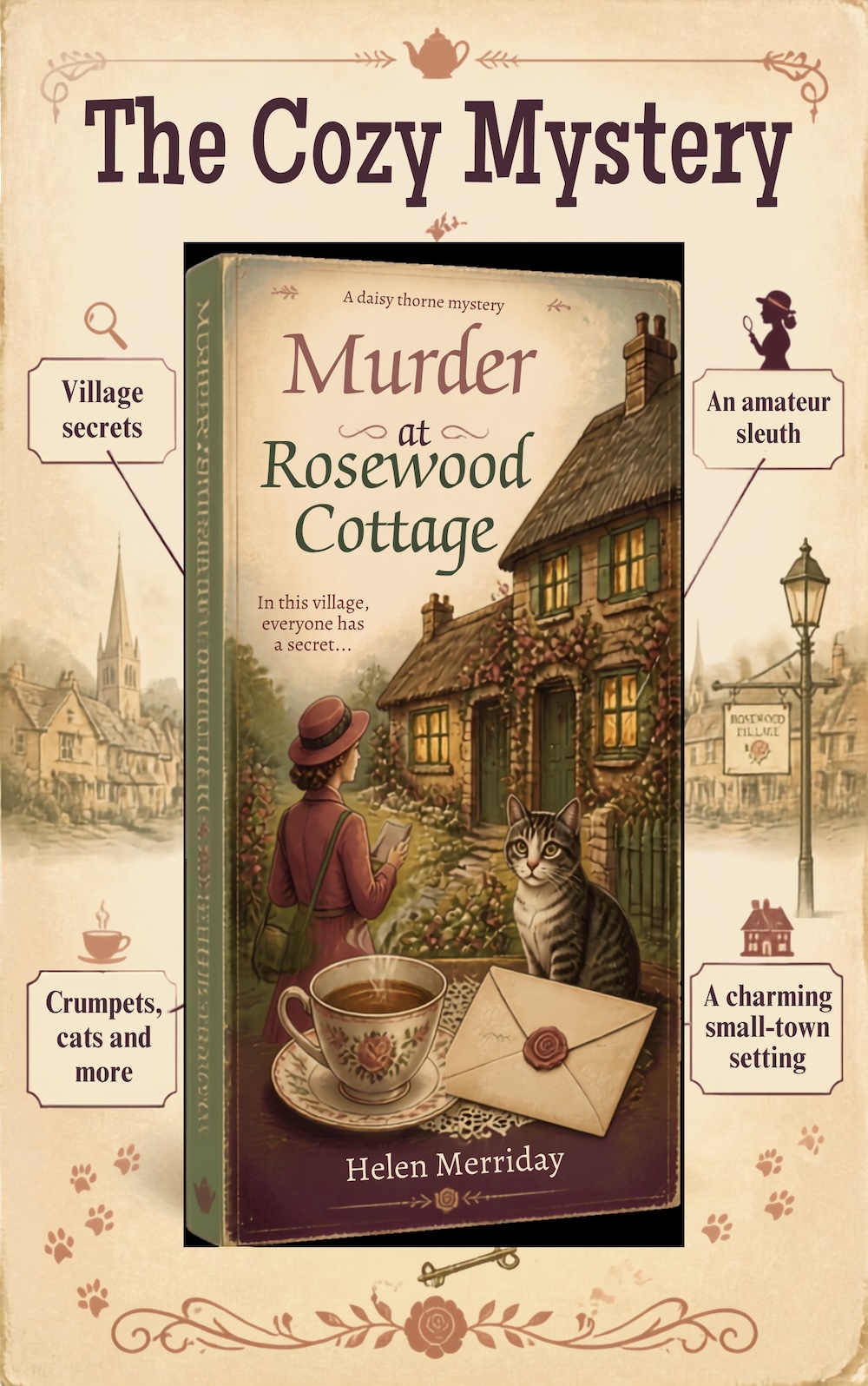
What is a cozy mystery?
A cozy mystery is a subgenre of mystery. It’s defined by its gentle, sometimes lighthearted, tone and strict content limits, not by who solves the crime.
The cozy mystery sprang from the traditional mystery (or whodunnit) category. Agatha Christie, Arthur Conan Doyle, and P.D. James (my favourite of the three) are well known traditional mystery authors. The traditional mystery contains a puzzle to be solved (usually a murder), a suspect pool limited by the setting (for example a train, a snowbound dinner party, a small village), clues laid out fairly so the reader can try to solve the mystery, and a sleuth who uses logic to solve the mystery.
The cozy takes the traditional mystery conventions and layers on tone and content requirements.
Cozy Mystery Requirements
| Tone | Light rather than dark, gentle |
| Content |
|
Mysteries that adhere to the above cozy rules will win the church women’s seal of approval. No clutching of pearls will occur at all.
In addition to the three mandatory content requirements, there are other conventions which may or may not be present in any given cozy mystery.
For example, the setting is usually a tight-knit community: a village, a small town, a bookshop, a bakery. Nothing prevents an author from using a larger urban centre as the broad setting, but in all likelihood the immediate locus of the story itself will be much more intimate, such as a bookstore or a close-knit neighbourhood in that city.
Other conventions include: the sleuth is usually an ordinary member of the community, most often someone who knows much about their fellow citizens; the victim’s body is discovered early but isn’t lingered over; the closed circle of suspects often know each other; and the resolution is satisfying and returns order to the community.
While the vast majority of cozy mysteries feature an amateur sleuth (that is, someone who is neither a police officer nor a licensed investigator), there are a few in which the sleuth is a current or former police officer, for example the One Man and His Dog Mysteries by P.C. James (not to be confused with P.D. James, author of traditional mysteries.)
The cozy mystery promises the reader comfort. You can enjoy the puzzle without worrying about dark or uncomfortable content. You know at the outset that you won’t be ambushed by a graphic autopsy, a torture scene, or profanity. That predictability is a feature, not a flaw, of cozy mysteries. It’s why the subgenre keeps such a loyal readership.
| Features of a Cozy Mystery | |
| Definition is based on: | Tone and content limits |
| Sleuth | 99% of time an amateur (no badge or license to investigate) |
| Violence | Off-the-page, minimal |
| Language and sex | Qualifies for church lady seal of approval |
| Setting | Usually small, tight community |
| Emotional intensity | Light and reassuring |
| Reader promise | Comfort and safety |
I am tempted to add one more feature to the above chart: humour. Perhaps that’s because the cozies that I write contain a healthy dollop of humour—the kind you find among people who have known each other for ages, the funny asides or throw-away lines that sum up a situation or a character accurately but without malice, or the ridiculous situations ordinary people find themselves in when they wander a bit out of their depth.
My cozies are short mysteries, featuring Persimmon Branch Worthing, a wealthy woman of a certain age who has lived in her small Canadian town for all her life (except for those years at finishing school which are never to be talked about.) Persimmon knows almost everything about everyone, and what she doesn’t know she wheedles out of her friends and neighbours. As with most cozy series, there are an inordinate number of murders in Persimmon’s town. In fact, Persimmon would tell you that not an event happens in Blossom City without something untoward occurring.
All the murders in Blossom City happen off the page, and no one in the town uses blue language (unless you count Sergeant Courgette, who is occasionally forced to say, “merde”), and sex shows up in the stories only in the form of innuendo. I’m confident the Persimmon Worthing Mysteries qualify for the seal of approval from church women (at least the church women my mother’s hung around with.)
What is not a cozy?
I often feel it’s easier to decide whether a story is not a cozy. Why? Because if the story does not adhere to even one of the cozy conventions, it will not qualify as a cozy. The tone must be light or gentle. The content must avoid profanity, extreme violence or graphic sex, and the murder must happen off the page. You don’t get three strikes. You get only one, and you’re out.
Since the majority of cozy mysteries feature an amateur sleuth and are set in small communities, people can easily assume that every story set in a small community or with an amateur sleuth is a cozy.
But that’s not the case.
My novel, Breaking News: Local Heiress Dead, is set in a small town in California. The sleuth is an investigative journalist, so an amateur. When I first workshopped the novel, the group categorized it as a cozy, primarily because of those two aspects. However, the tone of the novel is darker, and language is spicier, than a cozy reader would expect. There is also a romantic scene that, while not graphic, might make a church woman reach for the smelling salts.
So, no, that small-town-amateur-sleuth novel is not a cozy. It breaks the rule about tone. And some of the heat in the novel (whether from language or seduction) puts it offside the content rules.
How to tell at a glance if the book in your hand is a cozy?
Don’t rely merely on the shelf label in the bookstore, because bookstores and retailers use the term “cozy” loosely. Instead, search for the content signals.
Look for a punny or themed title, a cartoon-style cover or one that looks like a painting, a series built around a hobby or a shop, and back-cover copy that promises charm rather than intensity or uncomfortable themes.
Then read the first few pages. Is the murder off the page? Is the language rated PG? If so, it’s a cozy. You can feel confident that the book will deliver a puzzle without the dark.
Frequently asked questions
Is every cozy mystery an amateur sleuth mystery?
No, but almost all of them are. The overwhelming majority of cozies feature an amateur detective. A rare cozy might feature a gentle small-town police officer or a retired detective, keeping the cozy tone while shifting the sleuth outside strict amateur status, for example the One Man and His Dog Mysteries mentioned above.
What’s the difference between a cozy and a traditional mystery?
A traditional mystery keeps the classic structure (a puzzle, a closed circle of suspects, a fair-play solution) but allows more grit than a cozy mystery. Traditional mysteries can show violence, use realistic language, and have darker themes while still relying on deduction rather than action. A cozy is essentially a traditional mystery with strict content limits added.
How do I know if a book is a true cozy before I buy it?
Check the cover art, the title, and the back-cover copy. Covers that are cartoonish or evoke a sense of a painting, punny titles, and hobby or shop themes signal a true cozy. Then read the opening pages for tone: if the murder happens off the page and the language stays clean, it’s a cozy; if the crime and stronger language are on the page, it’s a broader amateur sleuth or traditional mystery.
Which of Charlotte Morganti’s books are cozy mysteries?
Charlotte Morganti’s cozy mysteries are the Persimmon Worthing Mysteries. They are set in the small town of Blossom City and follow Persimmon Branch Worthing, a woman of a certain age, who knows almost everything about everyone. Readers who love humorous cozies will enjoy these short mysteries.
In addition to short cozies, Charlotte also writes amateur sleuth, and private investigator mysteries. Check out Breaking News: Local Heiress Dead for her amateur sleuth line, and the Gabrieli Mysteries for her private investigator novels (which feature Gabe Gabrieli, a former lawyer turned part-time bartender/part-time private investigator.)
0 Comments